


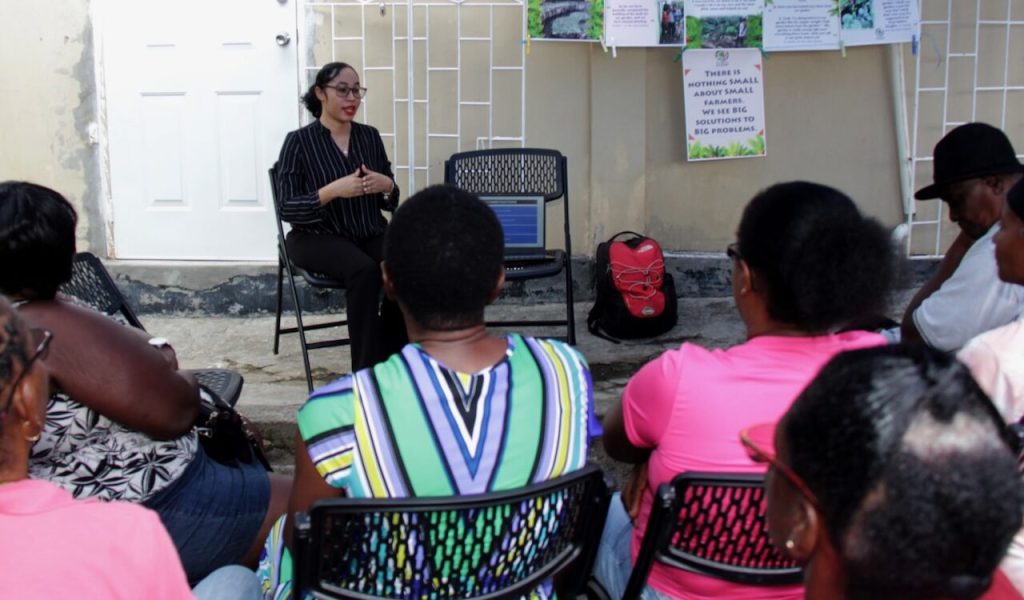
It might not seem like there is any link between having a water tank in one’s backyard and reducing non-communicable diseases (NCDs) such as diabetes and hypertension. “But, yes, a water tank can help you reduce your NCDs if you follow the path,” says Dr. Madhuvanti Murphy, a Senior Lecturer in Qualitative Research Methods at the George Alleyne Chronic Disease Research Centre, which is part of the University of the West Indies.
 Murphy was reflecting on the Intervention Co-creation to Improve Community-based Food Production and Household Nutrition in Small Island Developing States (ICoFaN) project, which was executed in St. Vincent and the Grenadines (SVG) and Fiji. Through a UK Research and Innovation grant awarded to the University of Exeter, this project was conducted with academic partners including The University of the West Indies, The University of the South Pacific, McGill University, Canada, and Université D’Etat D’ Haiti, as well as NGOs Richmond Vale Academy (RVA) in St. Vincent and the Grenadines and The Foundation for Rural Integrated Enterprises and Development in Fiji.
RVA executed the project in SVG. Initially, the project started in 2020 and the original plan was to construct 300 backyard gardens, explained Eden Augustus, a PhD student who is the SVG project coordinator for ICoFaN, adding that the COVID-19 pandemic resulted in budget cuts. “So, we tried to do the best of what we had and we decided to work with 100 families.”
Murphy, who holds a Doctorate in Public Health, said that St. Vincent and the Grenadines and Fiji were chosen for the execution of the project because they are Small Island Developing States with similar types of issues around high food imports, high NCDs, climate change, and sustainable food production so that they can have more local produce. “So, with the rates of obesity, chronic disease — diabetes, heart disease, and even cancers — being higher in low- and middle-income countries such as these countries, we want to really focus on how do we improve diets, how do we improve diet diversity as well, so that we’re using less of those highly-processed foods that are usually imported because we also have some locally-made or even regionally-made highly processed foods as well.”
 The project examined the ways through which the situation could be changed so that the local population could have more access to foods that are locally-grown, that are not processed and increase the consumption of fruits, vegetables and fibre. “Because we know that those things help in reducing the burden of disease, one of the ways we do this is by community based agricultural food production,” Murphy explained. The approach, through Richmond Vale Academy in St. Vincent and the Grenadines and FRIEND in Fiji was looking at how backyard gardening helps in terms of improving food and nutritional security. “It’s not just about having enough food, having access to food, but having access to the right types of food and having access to diverse produce that people can eat, to, in the long term, prevent NCDs or reduce NCDs.”
Murphy emphasised that the interventions are community-based adding that this is where it is important to have good NGO partners such as Richmond Vale Academy. “We, as academics, can do the evaluations and look at interventions and what can work, but the important thing is to really speak to folks on the ground who have been doing work and find out what actually works and what doesn’t and how we can help improve things.”
And this is why it is called intervention co-creation. “It’s not us coming in to tell anyone what we think they should do,” Murphy said. It is about working together with stakeholders to come up with interventions that can work — whether it’s something that worked elsewhere that can be tweaked to fit the local context, if it is appropriate for the country, the culture, and the geography of a particular place.
“Or, if it’s something that’s already in place, like Richmond Vale Academy,” Murphy adds, noting that RVA, under the leadership of its director, Stina Herberg, “has been doing “quite a lot of work already on backyard gardening. “So, how do we help in terms of co-design or co-creating something based on what is already being done that can also improve things?” Murphy said, reflecting on her approach.
The intervention
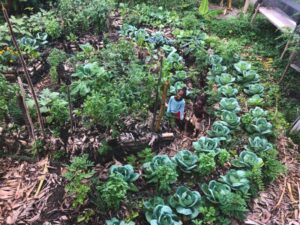
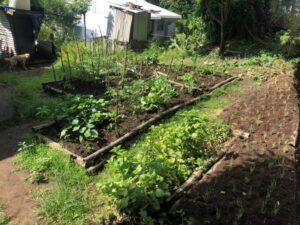
The intervention included everything: all the materials such as seedlings, seeds, bamboo logs, compost and all of the materials needed to organically – with an emphasis on organically — rebuild, or build backyard gardens. The project sought to understand the nutritional content and quality of what’s being grown and increasing the diet diversity so that participants are growing more things. “The hope is that the people are taking part in the intervention and growing a diverse group of crops and then that’s what ends up on their plate so that they have all the different food groups on their plates as well,” Murphy explained.
It focuses on a number of questions, including:
- How does backyard gardening, community backyard gardening work?
- Is the quality of what people are eating improving after they grow their own foods in their backyard gardens?
- Are people selling the food that they’re growing in their backyard gardens and buying less nutritious food?
The aim is to understand how people actually use these types of interventions, Murphy noted, adding that people have to use them the way that’s most appropriate for themselves as well. “What we don’t want, obviously, or what we hope doesn’t happen is that people grow what we consider good food, to sell that to then buy lots more highly-processed or unhealthy foods.”
 The idea is to educate people, helping them to understand what they should be eating and why. Augustus said that in St. Vincent and the Grenadines, the project worked with Richmond Vale Academy to co-develop 100 backyard gardens, working along with residents of the communities of Fitz Hughes, Chateaubelair, Petit Bordel, Rose Bank, Troumaca, Rose Hall, Barouallie, Pembroke, Vermont, Spring Village, Cumberland, Coull’s Hill and Campden Park. The project should have started in 2020, but the COVID-19 pandemic delayed the start to August 2021. Ms. Augustus trained people to collect data through surveys and interviews. The aim was to build capacity within the country and participants were also recruited and the intervention began in September 2021, lasting for a year. The second phase began in March 2022.
The interviews and surveys used pre-validated and developed tools that were fit to be used within the Caribbean, but specifically within St. Vincent and the Grenadines. They included an adapted version of the minimum dietary diversity for women of reproductive age, which was adapted for males as well within the setting, and the food insecurity experience scale.
The data collected showed that there were 177 adults in the 100 households. The children were excluded for ethical reasons in light of the sensitive topics of food security, food aid, and diet and nutrition. Two-thirds of the 177 adults were female and the data showed that more than two-thirds of the adults lived within large families.
 Augustus explained that even if the adults were not initially from large families, the size of their household expanded due to the April 2021 explosive eruption of La Soufriere volcano, which saw families housing displaced relatives. “So, we did the survey in two phases, which was phase one and phase two in terms of the valuation, the results of phase one was unexpected,” Augustus said. “We saw that over time, food insecurity did increase. However, we did not consider the impact of the COVID-19 pandemic as well as the La Soufriere eruption, which devastated persons in terms of their backyard gardens, destroyed crops as well as the loss of animals.”
The researchers, however, saw an increase in food security in phase two of the project. “And this, we think, is due to the fact that the persons who were recruited for phase two, were recruited a lot after La Soufriere erupted.” The project looked at the impact of the intervention or changes from the intervention to dietary diversity. Basically, dietary diversity is basically the amount of food groups that a person consumes. The Food and Agriculture Organization of the United Nation groups 10 different food groups: (1) grains, white roots and tubers, and plantains, (2) pulses (beans, peas and lentils), (3) nuts and seeds, (4) dairy, (5) meat, poultry and fish, (6) eggs, (7) dark green leafy vegetables, (8) other vitamin a-rich fruits and vegetables, (9) other vegetables, and (10) other fruits. However, the intervention only impacted six of the 10 food groups, Eden said.
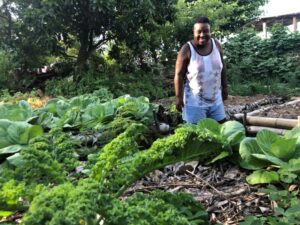
 “So, for both phases, we did see an increase with the dietary diversity which means that the intervention had positively impacted what persons were eating,” Augustus reported. “Persons stated that they were having a lot more spinach, specifically, and a lot more kale which falls within the dark leafy veg. They also say that they have a lot more pumpkin, a lot more carrots, which falls into the category of vitamin A-rich fruits and vegetables.”
However, the researchers wanted a more in-depth understanding of the impact of the intervention, and, therefore conducted interviews with 10 of the 100 families. “From the interviews, we found that persons spoke a lot about barriers and facilitators of backyard gardens.” Augustus said that as expected, some of the major barriers were the impact of COVID 19 pandemic restrictions, which led to persons not being able to sow seeds or seedlings. There was also the impact of the eruption of La Soufriere, which destroyed crops and devastated the small-scale farms and large-scale farms.
“One of the major barriers that we found also was the increase in pests, which was seen after the La Soufriere eruption, as well as theft. So even though persons are working hard to grow their backyard gardens, they would have persons who would come in and steal their produce that they would normally sell or that they would normally consume,” Augustus explained.
The backyard gardeners spoke about the black worms that they saw after La Soufriere erupted. “Many stated that they never saw this type of pest before, as well as white flies. Then there were the larger pests, such as the chickens and dogs that would come in and destroy the plants within their garden.”
On the other hand, most of the participants said that one of the major facilitators to backyard gardens was the support or assistance needed, not only from the government, and the NGOs, but from families and friends. “And because of the impacts of the COVID 19 pandemic and all the social distancing and physical distancing, this was confined,” Augustus said.
Augustus had some recommendations, based on the experience with this intervention. “The first recommendation, due to the fact that we saw a lot of positives, and that was primarily based on the increase in dietary diversity, we do want to expand the backyard gardens,” Augustus said. “We know that all the small island developing states are prone to disasters, but we think that every single person deserves to have in their own backyard gardens, being able to go within their own communities or behind their homes, and pick fruits and vegetables that they could consume.
 “One of the most important takeaways from this project is the fact that even though people are growing their own food, it does take some time before harvesting. So, if this intervention is to occur again on a larger scale, we do think that persons should be provided with food aid or food assistance that they need during the time that they are planting to harvesting.”
Marvin Douglas, a project leader at Richmond Hill Academy, welcomed the ICoFaN intervention. “We have created a lot of home gardens for a lot of home gardeners,” he said, adding that they produced a booklet to help farmers to continue with organic gardening even after the project. “We are very grateful and very pleased to have this opportunity and so are the garden owners. Due to the volcano, a lot of home gardens got wrecked or covered in ash completely in a red zone and orange zone. But because of the ICoFaN intervention, they reached out and assisted us in moving forward or helping those garden owners move forward in re-establishing the gardens that they once had.”
Murphy reiterated that a lot of the intervention work was really about farmers rehabilitating their home gardens after the impact of COVID-19 and the eruption of La Soufriere.
This included getting rid of the volcanic ash. She said that sometimes people look at a backyard garden or the activities such as the ICoFaN intervention and say, “Well, what does that have to do with public health?”
Murphy said it has everything to do with public health and NCDs. “And the reality is these things such as trying to recover gardens, trying to make sure that people have proper irrigation systems and water tanks so that they have water during drought periods, those are all sort of the back-end things that help to grow these gardens, that when we get produce from that we hope people will eat and prepare in a way that’s healthy and nutritious so that they live longer lives. Sometimes people don’t always see how we get from point A to point B; we have to spell it out for them.”
Over the last decade, RVA has focused heavily on helping St. Vincent and the Grenadines as well as its international students to respond, in their local communities, to the climate crisis.
One of its major programmes has been the home garden project under which it has established or rehabilitated hundreds of ecological backyard gardens across the country.
Ecological gardening combines various plant species that work together to replenish the soil as well as work as natural pest control.
“It has been very exciting to learn how you combine the different species, like using different plants that enhance the nutrition in the soil and how this can reduce the use of artificial fertilisers, protect the water sources, etc.,” the diplomat said. “The systems established here at the academy, in terms of recycling of water and biogas production, have opened my eyes about how much it is possible to achieve. The challenge is probably how to take it to a bigger scale. However, it is interesting and important to meet the challenges that we face and to learn about the possible alternative solutions,” Stirø said. “I am thrilled to know that there is a Norwegian lady as part of the team creating this academy,” the diplomat said, referring to Stina Herberg, who is has lived in St. Vincent and the Grenadines since 2006.
Meanwhile, Herberg thanked the ambassador for her visit, saying, “We are also proud that you chose to visit us.”
Richmond Vale Academy was established in 2002 and is a registered non-profit research and training institution in Richmond.
Since its opening, students from SVG and around the world have participated in courses centered on poverty reduction, environmental conservation and climate change awareness.
The academy’s programmes offer students the opportunity to directly influence positive change on the environment and in communities.