


Ecological Farming at Belle Isle
“The experience was wonderful. I got to learn a lot from the inmates while at the same time they also learnt from me. I gained a lot of respect and trust from them during my time there. They became like family because we interacted while learning at the same time,” RVA Permaculture Design Certificate (PDC) graduate Emris Stapleton.
“It is said that no one truly knows a nation until one has been inside its jails. A nation should not be judged by how it treats its highest citizens, but its lowest ones,” the late Nelson Mandela is remembered for saying, after his 27 year incarceration on Robben Island.
This statement would change the worldview on the rights of prisoners, imprisonment would not be a wasted time of suffering and humiliation, but one of reform, under humane conditions and personal development.
It has also been proven that cases of revidism by offenders are determinable by their conditions of incaseration, with those who have been treated more humanely are less likely to reoffend.
This is exactly what the government of St Vincent and Grenadines envisioned when the Belle Isle Correctional facility was built, to meet internationally accepted standards and replace the overcrowded and dilapitated Kingstown prison facility.
For prisoners to come out better the government stated then,“and not to come out closer to animals in the jungle than to civilized human beings.”
The Belle Isle Correctional Facility was officially opened in 2009, with minimum security inmates being its first residents. The first phase of building the prison cost EC$18.7 million, on a fertile scenic part of Belle Isle, with 33 dormitories to house 9 inmates each.
Years later the dream and vision upon which the facility was built continues to thrive, with prisoners receiving training in various life changing skills, that benefit both the Belle Isle Correctional facility, the inmates themselves and the community at large.
One such exposure inmates have received, is training in organic home gardening and permaculture design, as part of the agricultural rehabilitation program, which have enhanced the facility’s capacity to feed itself.
The Permaculture Design Certificate course offered by the Richmond Vale Academy, (RVA), is a seventy-two hour (minimum) training experience. Students who complete the full curriculum earn the internationally recognized Permaculture Design Certificate. It provides an introduction to permaculture design as set forth by the movement’s co-founder Bill Mollison, with credit for this course now accepted by a growing number of universities world-wide.
Part of the broader effort by the RVA meant to foster a culture of sustainable ecological home gardening, as a healthy, climate smart alternative which is also beneficial to the economy.
A graduate of the RVA, Permaculture Design Certificate, Emris Stapleton, used her newly found skills to impart crucial knowledge to selected inmates on the Belle Isle Correctional facility.
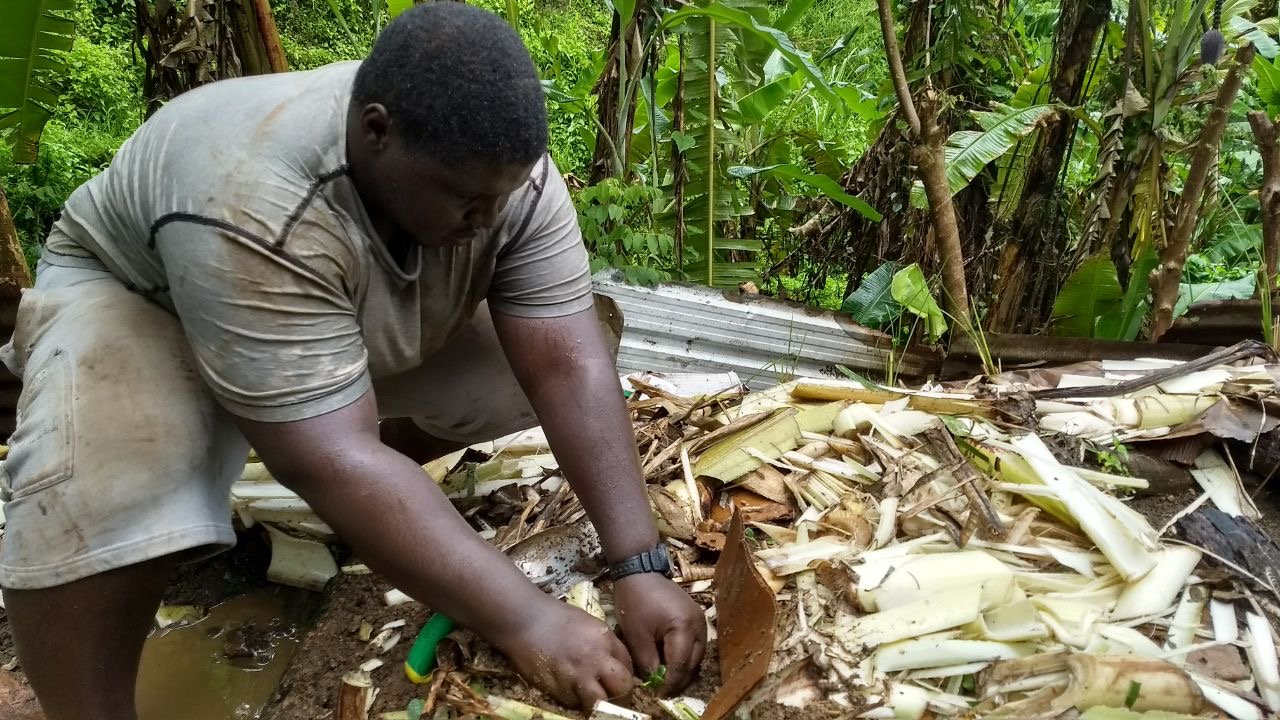
She found going to the Correctional facility as a trainer a fullfilling endevour, in which together with the selected inmates they would plant among other vegetables and herbs, chives, lettuce, celery, tarragon, cabbages, cauliflower, collard greens, spinach, parsley, including plantain, paw paw, pigeon peas, pineapples and watermelon. The facility has capacity to feed itself including other facilities too.
Stapleton an organic gardener, is also a field officer employed by the ministry of Agriculture, her busy schedule, during the time, included half a day of training at RVA, then one day teaching at Belle Isle Correctional facility as authorised and funded by the ministry.
Stapleton believed to be the first organic farmer employed by the ministry takes us through her experience.
The Belle Isle Correctional Facility is the biggest facility in SVG housing 288 inmates. When did you start your ecological farming programme there?
It wasn’t until December of 2017 after the completion of my garden that I thought about a garden at the prison. In January of 2018 after speaking with officers at the institution I did a trial bed to demonstrate what I actually wanted them to get involved in. I kept going there as a field officer for harvested crop data, that way I kept them updated on the progress with my garden. It was an ongoing process. Last year 2020 I was granted permission officially from the ministry of Agriculture to attend a half day practical session at Richmond Vale Academy, after which the following day I would go to the prison to teach the inmates what I had learnt the previous day at RVA.
There has also been training for the Permaculture Design Certificate (PDC), tell us more about the a) course b) the target students for training at the prison, for instance did you have a certain selection criteria?
The PDC course started on the 6th of September and ended on the 18th of the same month in 2020 at RVA. The course was very challenging, exciting too and there were a lot of things to learn. A six month course to be completed in two weeks. It took long hours of classroom work and lots of practical exercises to actually get everyone involved. And to show that we really understood what we were taught so that later when we go out on our own we would know exactly what we are supposed to do. It was challenging but worthwhile.
There were about nine persons involved in the program at the prison. They were selected by the farm officers at the institution, on the advise of the farm supervisor.