


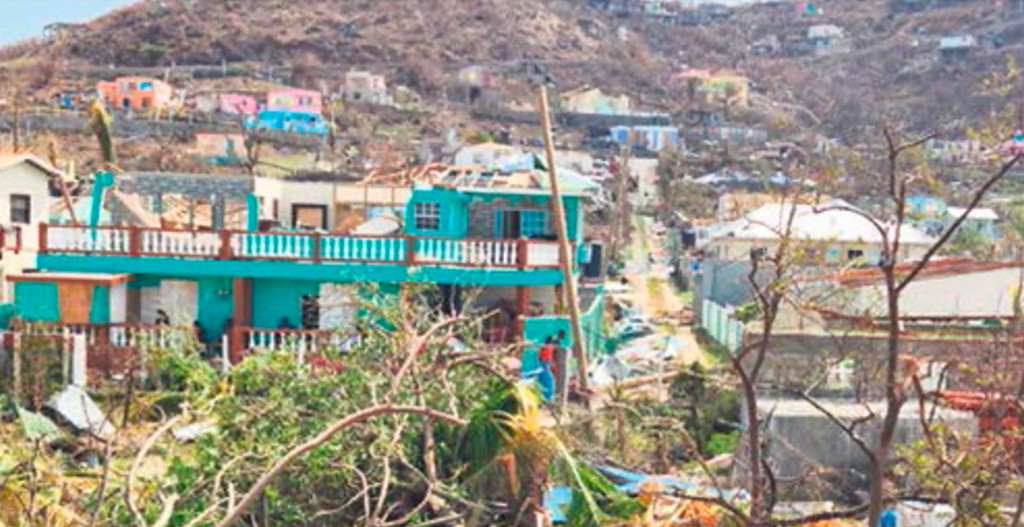
Saturday the 29th of June, the February Climate Team from RVA returned to the main island of St. Vincent after a 4-day visit to the most southern island of the Grenadines – Union Island. Two days later Hurricane Beryl hit as a category 4, and within only a few hours 98% of all buildings on Union Island got partly or completely destroyed and 6 people lost their lives.
The island has a population of 3000 people, and at this moment, 500 or more have already evacuated to St. Vincent, where they have taken refuge in schools turned into shelters and some are also staying with family and friends.
At Richmond Vale Academy we moved all loose structures inside and stayed there till the hurricane had passed. Luckily there were only small damages to our buildings, but we lost our banana and plantain fields and many trees around the campus.
In cases like this electricity is turned off across the island for risk of accidents when cables go down so all electricity along with phone signals and water was off. Our solar panels provided power but no WIFI to connect with people.
When hurricane Beryl had passed, we went to Fitz Hughes and Chateaubelair, our closest neighboring towns. We heard that some houses had serious roof damage, but when we arrived, a small group of villagers were already fixing roofs. The people in the surrounding villages all help each other. We were told that they mostly needed professional roof builders and that the villagers would be able to help each other and do the clean up on their own.
This is the situation all over St Vincent and the Grenadines – after having been hit by one “natural disaster” after the other people have learned to support each other in every possible way. This was dramatically the case with the volcanic eruption in 2021.
However, Rose Hall, another village on higher elevation, was hit hard. The RVA team went there on the following Saturday and teamed up with residents to break down and remove debris and trees scattered across the town.
The utility companies have managed to restore most of the water, electricity, phone and internet services now, after a major effort across the islands.
At RVA we have been very lucky. We have strong concrete buildings built to withstand hurricanes and earthquakes. We have solar panels which are off grid, so by economizing with the usage, we have had enough stored on our batteries to cater to our basic needs.
We also have a rainwater collection system and were able to place more drums and buckets to catch the surplus water that came with the heavy rains after the hurricane.
So, why did this happen?
It is NOT normal for St. Vincent and the Grenadines to have such strong hurricanes. The last ones were Hurricane Tomas in 2010, and Hurricane Elsa in 2021, both only category 1 with proportionate damage and havoc to the islands, but not to this grade of devastation.
In 2013, St. Vincent and the Grenadines was affected by serious flooding which left damage still visible to this day.
Usually the hurricanes come close, but then pass north of the country, and under normal circumstances they start in August….so this year 1 month earlier.
People talk about Climate Change. The reality is that we are dealing with a climate break down! Nothing is in sync anymore. The natural disasters and the extreme weather are getting more and more frequent and increasingly violent.
This year is predicted to see more hurricanes and tropical storms in the Caribbean. The main reason for this is the warming of the oceans. This comes from the rising amount of Green House Gases, produced around the planet wherever there are dense populations and industrial activity.
The last 10 years have been the ocean’s warmest decade since the 1800s. The most impoverished populations are most at risk from these global trends, simply for the lack of resources to defend themselves. Industrial regions contribute the most to the warming trends, and the many decisions that choose profits above environmental stewardship are major contributors. As long as we allow these trends to continue without regulation and accountability, we will be unable to reverse the trends, and the risks to all species on the planet will continue to increase. We need to take another approach to managing resources and production if we are to survive.
Elisabeth Axelsen, Teacher.