


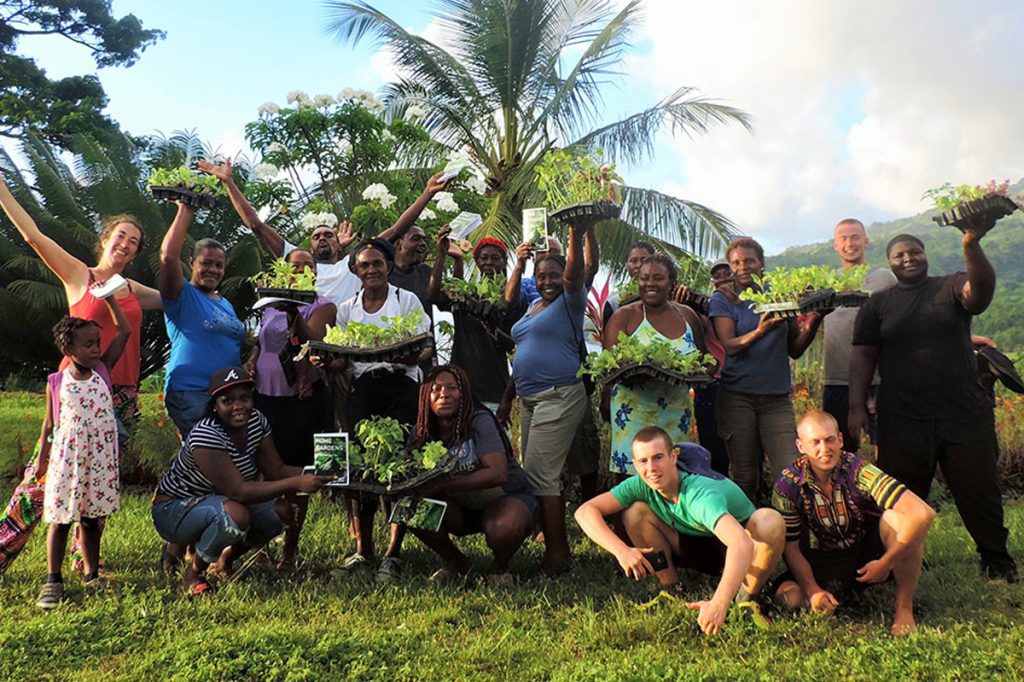
Here are some of the answers we got from former students who completed the 6 months Climate Activism program
1. Why did you decide to become a volunteer?

VIVIAN – Uruguay: A long time ago I had this innocent idea that I wanted to make the world a better place, I wanted to go far away to Africa, to improve it, to change it. Fortunately life made me wait long enough to learn some things before.

GUSTAVO – Venezuela: I wanted to have the experience and learn about working with communities outside my hometown. I was curious about meeting and working together with people within the volunteering world; so many different cultures and languages but everyone share the same passion for helping and learning.
TOBIAS – Germany: I never really decided to become a volunteer it just kind of happened to me..I just finished school and I wanted to spend my gap year somewhere abroad doing some kind of work. I honestly didn’t have anything particular in mind, so I was just browsing the web when found a website that had a display of one of your programs at RVA. So I did some research an contacted you (and I’m really happy I did). You contacted me back very fast and so I became a volunteer at RVA.
CAMILLE – France: Passionate about biology and a little naive, I decided to work in research, in order to help medicine breakthrough and eradicate diseases. The reality is a little different and despite the noble intentions of researchers in general, it is difficult to grasp the real impact of our work. Developing a new drug takes years and is a very tough process, not a lot of (what-seem-like-promising) compounds make it to the patients in the hospital… Through personal reflection, introspection and a lot of external input, I am also coming to the conclusion that, even though it’s extremely important to work on finding cures to cancers and all sorts of nasty diseases, it should be a priority to live a healthier life, more respectful of nature and of ourselves. We should fight the causes (before the consequences!), of all the illnesses that arise in the world, think twice about our way of life and be more mindful of our surroundings.
Participating in a volunteering mission would allow me to use and improve certain qualities and skills that I did not truly exploit in my previous work. And to find a path for my future professional journey that is in accordance with my sensitivity and my values.
2. What do you do now and what practical skills did you gain from this program to prepare you for this?
VIVIAN: First, I learned that the idea itself of trying to improve, trying to change something besides myself is not right. There were already things that worked and were just right and good before people wanted to change and improve them, having in mind a single model that I wanted to copy. So, during this program, I learned to listen, to observe, to debate, practice my patience and tolerance, probably not enough, but the most important was that I participated week after week in a cooperative construction of what we wanted to do as a group, as a community.
That was the greatest challenge all the time, getting out of our selves and our egoism to try to do something common with people from completely different points of view, culture, language, etc. I saw and got to know people who just gave the best of themselves, what they learned; what they loved to do, what they discovered, they were giving and providing most.
GUSTAVO: I’m working as a engineer in Europe and during my time as volunteer I got better in my communication skills, learned English and basic Portuguese. I think the most important skills I got are how to teamwork with people from very different backgrounds and cultures with tolerance and respect.
TOBIAS: After I finished school I had no idea what to do next (which is one of the reasons I decided to go abroad), of course I did have some plans but nothing meaningful. After coming back from SVG I knew I wanted to do something ecological/environmental, maybe something with renewable energy…So I moved from Hamburg to Lübeck and I’m studying environmental engineering and management in my second semester. I really enjoy it. I gained so many new skills in SVG so there is no way I could list them all. But I think the one with the most impact on my life is planting knowledge and farming/gardening. We now have a bed in our garden and my dad is getting into gardening now as well. April is the time in Germany to start the seeds and I’m looking forward to putting them into our garden and harvesting them when the season ends.
CAMILLE: I became a leader for a climate compliance conference team along with two other teachers. I worked with young people from all over the world and with all backgrounds imaginable, to try and make a difference! Crossing to the other side and becoming a team leader / teacher / facilitator is a great challenge.
It’s quite a learning process… I am leading a group of 30 amazing students that are super fun to work with, in a really nice atmosphere and with a lot of ideas!! We learn a lot from each other. And after six months, I can really see how all of us are evolving, gaining confidence, improving our English/communication Skills, and opening up to the community!!!
3. What would be an important moment, event, achievement or person you met during your time in the program?
VIVIAN: I worked, and worked, and worked with my hands, with my mind, with my character and in the end I saw a beautiful garden full of vegetables, a modern chicken coop surrounded by trees, seedlings and I had the time of my life in the most incredible and beautiful place.
GUSTAVO: For me it was a very important achievement to learn English from 0 and after few months to be able to make presentations and communicate fluently with my teammates and the community. Also I met a lot of nice people from around the world and we still keep very lovely relationship and meet/talk to each other every time we can.
TOBIAS: For me it was always an important moment when we worked together with the locals, like working with them in the home gardens and teaching them permaculture skills, they also taught me new things. Building the classroom together with the students of the Petit Bordel School was an amazing experience.
CAMILLE: The Permaculture Design Course with Luke was a very important step for me and it was a great opportunity. We learned about the philosophy behind permaculture and it is just so appropriate to the community life that we are living here together! Earth Care, People Care, Fair Share! It is such a down to earth, simple, and straightforward philosophy that it sounds like it should be Common Sense. And yet it is so far from the “modern” life we are living. I hope that I can apply this philosophy to my life, learn from it and lead a more fulfilling life thanks to it.
4. Has your work as a Climate Activist impacted your decisions for your future?
VIVIAN: First, I learned that the idea itself of trying to improve, trying to change something besides myself is not right. There were already things that worked and were just right and good before people wanted to change and improve them, having in mind a single model that I wanted to copy. So, during this programme, I learned to listen, to observe, to debate, practice my patience and tolerance, probably not enough, but the most important was that I participated week after week in a cooperative construction of what we wanted to do as a group, as a community.
That was the greatest challenge all the time, getting out of our selves and our egoism to try to do something common with people from completely different points of view, culture, language, etc. I saw and got to know people who just gave the best of themselves, what they learned; what they loved to do, what they discovered, they were giving and providing most.
GUSTAVO: Yes. After learning and working in RVA my perspective changed on how I live my life and my relationship with nature. I have a lot of empathy, respect and tolerance for others as a result of my days in RVA, around people with different cultures and passions.
TOBIAS: As I already mentioned without RVA I wouldn’t be studying environmental engineering. Also I’m growing my own food now (at least some of it) and I’m living so much more aware of my surroundings.
CAMILLE: Being a climate change activist has proven that this is the path I want to follow. I haven’t decided yet what the next steps will be, but for sure my life will be full of people making the world a better place, full of gardening and producing my own food, full of respect for all forms of life, full of knowledge sharing and full of continuous learning! I am excited to see where that leads me!